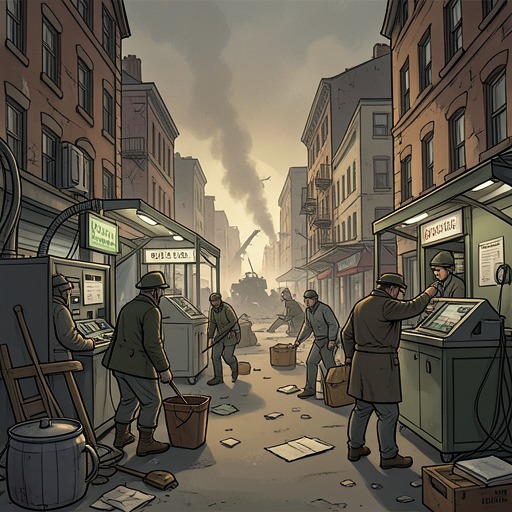
South Africa’s Attempt to Force a Crossing of the Kuvo River Front
Another Day of LifeThe South African attempt to force a crossing of the Cuvo River was a limited but consequential episode in the southern fighting: the river and its destroyed bridges checked an advance, while rain, difficult movement, and the need for reinforcements shaped what either side could do next. Rysiek’s account follows the front from its cotton-warehouse headquarters to a night battle and the return of wounded soldiers to Luanda, showing how a river crossing depended not only on firepower but on transport and supply.
The river as a defensive line
The front ran along the Cuvo River. The South African units had not broken through because the bridges had been blown up. The account says they had not been prepared for this and were waiting for pontoon bridges. This left the river as a practical obstacle to their advance, but not as proof that the threat had passed: both sides exchanged sporadic fire, and neither felt strong enough to attack. The immediate situation was therefore a tense standstill, with the crossing unresolved and the next move dependent in part on whether the South Africans could bridge the river.
The front’s position was described from a headquarters established in large cotton warehouses. Soldiers walked through cotton that reached their knees, and white moss grew on their uniforms and heads. The cotton provided a place to sleep that was warm and comfortable, an unusual pocket of shelter beside a line where the opposing forces remained close enough to exchange fire. At dawn, the account’s movement along the front revealed a different environment: heavy rain, piercing cold, mud, and a car that skidded before its occupants had to continue on foot. These conditions did not determine the outcome by themselves, but they formed the setting in which movement and support had to be organized.
An attempted crossing and its immediate aftermath
The crossing attempt became a night battle about sixty miles east of Porto Amboim. The South African forces tried to force the river, but the account reports that they had not broken through the defensive line. It does not describe a completed crossing or give a detailed sequence of the fighting. Instead, its clearest measure of the encounter is its aftermath: Rysiek returned to Luanda by plane with several badly wounded soldiers, both local and Cuban, lying on the floor. Two were unconscious. Some African women sat motionless in a corner of the aircraft. The restrained description records the human cost without claiming more about the battle than the evidence establishes.
The aircraft landed in Luanda in a downpour. Two heavy Antonov aircraft stood on a side apron after bringing mortars. The arrival of those weapons, alongside the evacuation of wounded, placed the episode within a continuing contest over the means to hold the front. The account does not say that the mortars decided the river fight; their presence instead shows that equipment was still being moved toward the conflict even as casualties were being carried away from it.
Reinforcement, supply, and movement
The forces expected at the river position included two companies of Cuban soldiers and a company from Guinea-Bissau, due to arrive by ship the following day. Two MPLA units were also on their way overland. These planned arrivals suggest that the existing defenders did not regard their position as self-sufficient. With the opposing sides both described as too weak to attack, reinforcement mattered as a prospect rather than a completed change in the balance: the account records who was expected and how they were to arrive, not whether they reached the front on schedule.
The evacuation itself depended on Ruiz’s precarious air service. Elsewhere in the same account of the war, he is described as piloting the MPLA’s only aircraft in Luanda, an old DC-3 that carried ammunition and food to besieged positions and brought serious casualties back. In this episode, his plane again served as a link between the southern front and the capital, carrying wounded through clouds and rain. The river battle thus appears alongside a wider logistical reality: fronts separated by distance relied on a small number of routes and aircraft to move people and supplies. Those arrangements could sustain a position, but they also made the movement of reinforcements and casualties vulnerable to delay and disruption.
Reporting the front
After returning, Rysiek sent a dispatch to Warsaw announcing that he had come back from the southern front and that its boundary now ran along the Cuvo River. He deferred the detailed description and sent the major news first. That choice gives the river line a double significance. It was a concrete military boundary, marked by a failed attempt to cross and bridges that had been destroyed, but it was also the organizing fact of the reporter’s account: the fighting, the wounded, the expected reinforcements, and the movement back to Luanda all became legible through the position of the front along the river. The episode ends not with a declared victory, but with the front still held, an attempted crossing unresolved, and the next phase dependent on transport and incoming forces.